How Hard Water Affects Plumbing in Las Vegas Homes
September 30, 2026

 8:00am – 6:00pm, Mon-Thur : 8:00am – 4:00pm, Fri-Sat: Sun-Closed
 Americanwood St, Las Vegas, NV 89130, United States
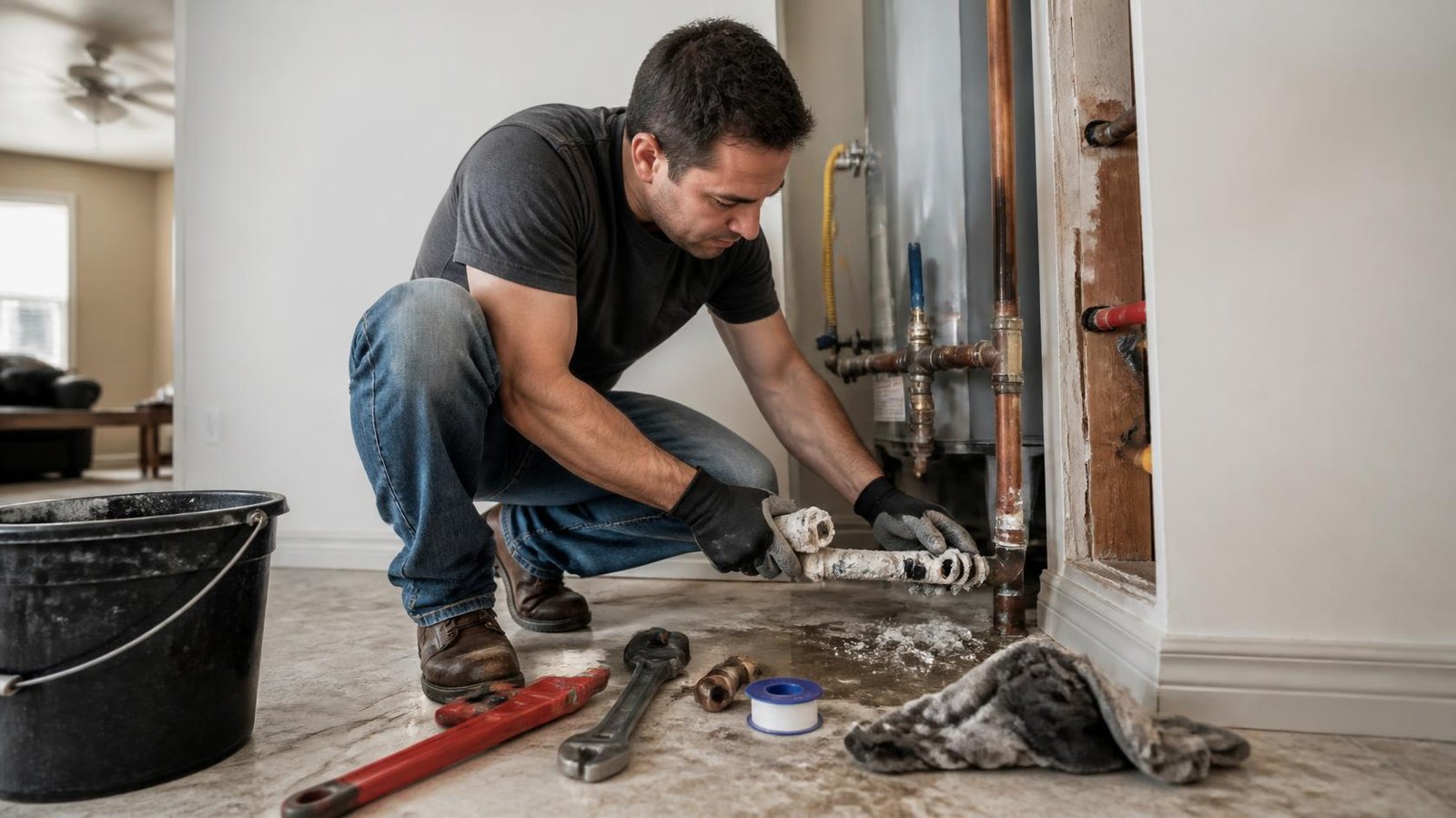
If you’ve noticed white deposits around a faucet, spots on fixtures, scale on a showerhead, or mineral residue where water regularly dries, hard water may be contributing to the problem.
Hard water is especially relevant for Las Vegas homeowners because the local water supply contains naturally occurring dissolved minerals. These minerals aren’t the same thing as dirt or contamination, but they can leave scale behind and affect plumbing fixtures and water-using equipment over time.
Understanding what hard water is—and what it isn’t—can help you make better decisions about faucets, water heaters, plumbing maintenance, and water treatment.
This guide explains how hard water can affect plumbing in Las Vegas homes, where mineral buildup commonly develops, what warning signs to look for, and the difference between water filtration and water softening.
Hard water is water containing relatively high concentrations of dissolved minerals, particularly calcium and magnesium.
Water picks up minerals as it moves through rock and soil before entering the water supply. That means hardness is a naturally occurring characteristic of water rather than necessarily an indication that something is wrong with it.
Calcium and magnesium are the primary minerals associated with water hardness.
The minerals are dissolved in the water, so you usually can’t see them when you fill a glass from the faucet. They become much more noticeable when water evaporates or when mineral scale accumulates on a surface over time.
That is why hard water often becomes visible around:
The visible residue is commonly called mineral scale or hard-water buildup.
Yes. Hard water is a normal consideration for homes in the Las Vegas Valley.
Southern Nevada’s water supply and water-quality conditions are documented by local water authorities, including the Southern Nevada Water Authority. Water hardness can vary based on water source and operating conditions, so homeowners looking for current measurements should consult official local water-quality information rather than relying on a single permanent number.
For plumbing purposes, the important point is that Las Vegas homeowners can reasonably expect mineral hardness to play a role in how fixtures and certain water-using components age and require maintenance.
Water hardness by itself should not be confused with water contamination.
“Hard” describes the concentration of minerals such as calcium and magnesium. Drinking-water safety involves a much broader range of water-quality standards and substances.
If you have questions about the current quality of Las Vegas drinking water, use official reports from the Southern Nevada Water Authority or your specific water provider.
One of the most obvious effects of hard water is the white or chalky material that accumulates around faucets.
When hard water reaches a fixture and then evaporates, water disappears into the air while some dissolved minerals remain behind.
Repeated cycles of wetting and evaporation can gradually create visible deposits.
Mineral residue commonly becomes noticeable around the:
The faucet aerator can be particularly susceptible because it contains small openings through which water must pass.
As deposits accumulate around those openings, the flow pattern can become irregular or restricted.
If your kitchen fixture is leaking, damaged, or experiencing persistent flow problems, see our kitchen faucet repair and installation services in Las Vegas.
It can contribute to reduced flow in particular fixtures.
For example, mineral deposits around the openings in an aerator or showerhead can restrict water passing through them. The homeowner may perceive this as a water-pressure problem even though the actual issue is localized at the fixture.
These concepts aren’t necessarily the same.
If only one faucet has weak flow while other fixtures work normally, investigating that individual fixture and its aerator can make sense.
If low pressure affects numerous fixtures throughout the house, possible causes extend well beyond mineral buildup.
Other possibilities can include:
Hard water should therefore be considered one possible contributor rather than a universal explanation for low water pressure.
For broader troubleshooting, our guide to common Las Vegas plumbing problems explains several other causes homeowners may encounter.
Kitchen faucets are exposed to water many times every day, making them one of the easiest places to observe mineral accumulation.
Deposits may collect externally around the aerator and fixture surfaces, while mineral scale can also affect components that are regularly exposed to water.
Potential symptoms include:
However, dripping should not automatically be blamed on hard water.
A faucet that continues dripping when shut off can have a worn cartridge, seal, washer, O-ring, or another mechanical problem. Mineral accumulation may coexist with normal component wear.
For a broader overview of household plumbing issues, read our guide to common plumbing problems in Las Vegas homes.
Showerheads contain numerous small water openings, which makes visible mineral accumulation easy to notice.
Over time, deposits can partially obstruct individual openings.
You might notice:
These symptoms do not necessarily mean there is a problem with the home’s entire plumbing system.
If normal flow exists elsewhere in the home, the problem may be concentrated at the showerhead or fixture.
Toilets continuously interact with the home’s water supply, so minerals can also accumulate on components and surfaces where water regularly sits or moves.
Mineral deposits may become visible inside the bowl or tank, depending on conditions.
However, a toilet that runs continuously is more commonly associated with components responsible for controlling and sealing water within the tank, such as the flapper, fill valve, float, or flush-valve assembly.
Hard water should not be used as a catch-all diagnosis for every toilet problem.
If your toilet is old, unreliable, frequently clogged, damaged, or repeatedly requiring repairs, explore our toilet replacement services in Las Vegas.
Water heaters deserve particular attention because heating hard water can make mineral-related issues more noticeable.
In a conventional tank-style water heater, minerals and sediment can accumulate at the bottom of the tank over time.
Sediment is material that settles rather than remaining suspended in the water.
Depending on local water conditions, mineral content can contribute to accumulation inside some water heaters.
Over time, sediment may be associated with:
The effect depends on the type of water heater and its condition.
Popping or rumbling sounds are sometimes associated with sediment accumulation in a tank-style water heater, particularly when water or steam moves through accumulated material.
But sound alone isn’t enough to make a definitive diagnosis.
Water heaters contain multiple components, and different problems can create different noises. The unit should be evaluated based on its design, age, condition, and symptoms.
If you’re experiencing hot-water problems, leaks, or unusual performance, see our water heater repair and installation service in Las Vegas.
Mineral accumulation can be one factor affecting water-heating equipment, but it’s misleading to assign every premature water heater failure to hard water.
A water heater’s service life can also depend on:
Rather than relying only on the age of a unit or the hardness of the water, homeowners should pay attention to actual symptoms such as declining hot-water performance, leakage, unusual sounds, or repeated component failures.
This question requires some nuance.
Mineral scale can accumulate in certain plumbing components and under certain conditions, but statements such as “hard water will clog all your pipes” oversimplify the issue.
Plumbing performance depends on pipe material, age, water chemistry, temperature, flow conditions, and other factors.
Older plumbing can also have restrictions or corrosion unrelated to water hardness.
If several fixtures are experiencing low pressure, unusual flow, or other problems simultaneously, diagnosing the larger plumbing system is preferable to assuming mineral scale is the sole cause.
For help with plumbing-related issues, review our Las Vegas plumbing services.
Hard water often reveals itself through recurring patterns rather than one dramatic plumbing failure.
You may notice:
Some homeowners also notice effects involving cleaning and soap performance, although those concerns aren’t necessarily plumbing failures.
Symptoms such as the following should not automatically be attributed to hard water:
Those symptoms may require a different type of diagnosis.
Hard water and mineral buildup can contribute to wear or scaling in some plumbing components, but a leak should not automatically be diagnosed as a hard-water problem.
Leaks can occur because of:
The location and source of the leak matter much more than simply knowing that the home has hard water.
Active leakage should be addressed promptly because prolonged moisture can damage cabinets, flooring, walls, and ceilings.
If a plumbing leak has already affected a wall or ceiling, the water source should be corrected before arranging sheetrock repair in Las Vegas.
Mineral scale and corrosion are not the same process.
Scale is a deposit of minerals left on or within surfaces and components.
It may appear:
Corrosion involves deterioration of a material through chemical or electrochemical processes.
Its appearance varies according to the material involved.
The distinction is important because simply cleaning scale will not repair a component that has actually deteriorated or failed.
Not necessarily. This is one of the most important distinctions for homeowners considering water-treatment equipment.
Water filtration and water softening accomplish different objectives.
A water filtration system is designed to reduce particular substances depending on the technology and filter media used.
Different filtration systems target different water-quality concerns.
A filter should therefore be selected based on what you actually want to reduce or change in the water.
Traditional water softeners specifically address calcium and magnesium hardness, commonly using ion exchange.
That makes softening conceptually different from general filtration.
A useful way to understand the relationship is:
Water filtration → targets particular substances according to filtration technology.
Water softening → specifically targets hardness minerals.
Some water-treatment systems combine technologies, but homeowners shouldn’t assume that every filtration system automatically eliminates hard water.
If you’re evaluating treatment options, explore water filtration systems for Las Vegas homes.
Because minerals are present in the water supply, ordinary cleaning won’t change the hardness of the incoming water. It can, however, help manage deposits that appear on accessible surfaces.
Regularly cleaning faucet aerators, showerheads, and fixture surfaces can prevent layers of visible residue from becoming more difficult to remove.
Always consider the fixture manufacturer’s cleaning instructions because some finishes can be damaged by aggressive chemicals or abrasive materials.
If one faucet develops an unusual spray pattern or noticeably reduced flow, the aerator is one place to investigate.
The cause may be mineral accumulation or debris rather than a whole-house pressure issue.
Changes in hot-water availability, unusual sounds, leaks, or declining performance can indicate that the water heater deserves attention.
Avoid assuming that every symptom can be solved by flushing or DIY maintenance. Water heaters involve hot water, pressure, and—depending on the unit—electricity or gas.
A small fixture leak can create problems beyond wasted water.
Repeated moisture may damage cabinets, flooring, drywall, finishes, and nearby materials.
Hard water’s most obvious bathroom effects are usually deposits on surfaces and fixtures.
Scale can become noticeable around:
But bathroom deterioration shouldn’t automatically be attributed to water hardness.
Bathrooms also deal with moisture, caulk deterioration, plumbing leaks, ventilation issues, and normal wear.
If you’re planning broader upgrades involving fixtures, walls, vanities, or finishes, see our bathroom remodeling services in Las Vegas.
Visible mineral residue alone isn’t necessarily evidence of a plumbing failure.
The issue becomes more relevant to plumbing performance when buildup is associated with symptoms such as:
Even then, determining the actual cause matters.
For example, replacing a faucet aerator won’t solve a hidden plumbing leak, and installing a water filter won’t necessarily solve water hardness.
Matching the solution to the problem prevents unnecessary repairs and equipment purchases.
Consider professional evaluation when you experience:
Water-related symptoms can overlap, so identifying whether the issue involves a fixture, water heater, plumbing connection, water supply, or treatment equipment is an important first step.
You can contact Save More Handyman Services for plumbing issues.
Las Vegas Valley water is considered hard because it contains dissolved minerals such as calcium and magnesium. Exact hardness can vary, so consult current information from the Southern Nevada Water Authority or your water provider when you need specific measurements.
White or chalky residue around faucets is commonly mineral scale left after water evaporates. Calcium-related deposits are particularly associated with hard water.
Mineral scale can accumulate around the small openings of a faucet aerator and restrict flow. Debris can also cause aerator restrictions, so the aerator should be inspected before assuming the home’s overall water pressure is low.
Water repeatedly reaches the showerhead and then evaporates from its surface. Minerals can remain behind and gradually produce visible scale around the nozzles and fixture.
Hard water can contribute to mineral accumulation on and within fixtures, but faucet leaks also commonly result from worn cartridges, seals, washers, O-rings, and other mechanical components. The actual cause should be identified before deciding on a repair.


 Americanwood St, Las Vegas, NV 89130, United States
 savemorehm@gmail.com
Get a Free Estimate Today!
Call us for a cost estimate over the phone.
Copyright © 2026 Save More Handyman Services. All rights reserved