Why Is My Water Heater Not Producing Enough Hot Water? Causes & Solutions
October 23, 2026

 8:00am – 6:00pm, Mon-Thur : 8:00am – 4:00pm, Fri-Sat: Sun-Closed
 Americanwood St, Las Vegas, NV 89130, United States
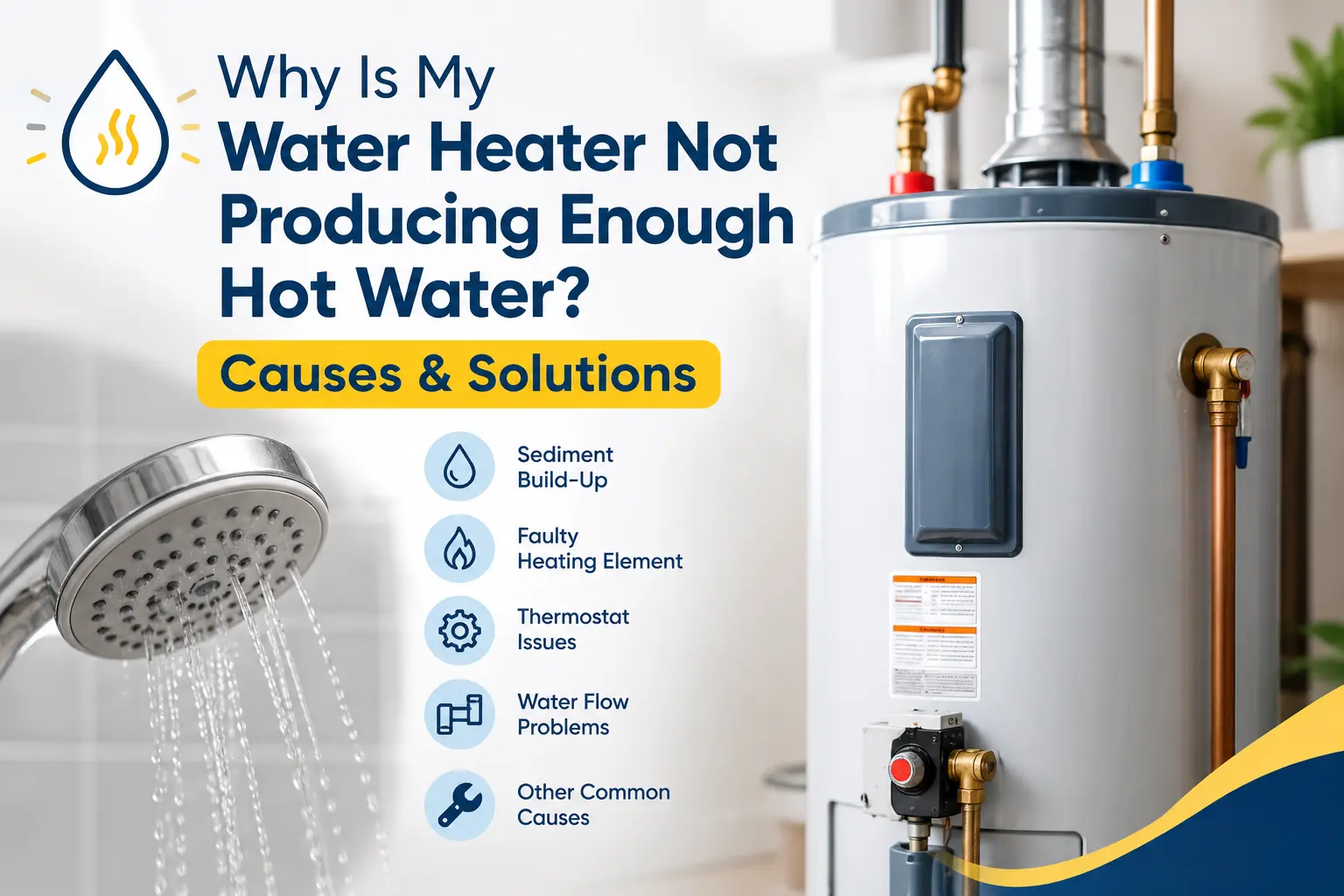
Running out of hot water halfway through a shower can be frustrating, especially when your water heater previously supplied enough hot water for the entire household. Sometimes the problem develops gradually, while other times the water suddenly becomes lukewarm or cold without an obvious explanation.
A water heater that isn’t producing enough hot water may have an issue with its heating elements, thermostat, burner, temperature controls, or other internal components. However, the problem isn’t always a malfunction. Increased household demand, an undersized water heater, fixture-related issues, or mineral sediment can also affect hot-water availability.
For homeowners in Las Vegas, hard-water mineral accumulation is another factor worth understanding. Southern Nevada’s water contains dissolved calcium and magnesium, which can contribute to scale and sediment in certain water-heating systems.
The key is determining whether your water heater is failing to heat water, storing too little hot water, or struggling to meet your household’s demand.
In this guide, we’ll explain why a water heater may stop producing enough hot water, how to recognize different symptoms, and when professional repair or replacement may be necessary.
If your water heater is experiencing recurring performance problems, explore our water heater repair and installation services in Las Vegas.
Several factors can affect how much hot water is available.
Some involve the water heater itself, while others relate to how much hot water the household uses.
Common causes include:
The symptoms can help narrow down the possibilities.
For example, a water heater that never produces adequately hot water may have a different problem from one that produces hot water initially but runs out after several minutes.
One of the simplest explanations for insufficient hot water is increased demand.
A water heater can operate normally and still struggle if several fixtures or appliances require hot water around the same time.
Common examples include:
When multiple activities occur close together, demand can exceed the water heater’s available capacity.
A conventional storage water heater holds a limited volume of heated water.
As hot water leaves the tank, incoming cold water replaces it.
The heater then needs time to restore the stored water to the appropriate temperature.
If several showers occur close together, hot water may be used faster than the system can recover.
Consider whether:
If the issue occurs only during unusually heavy demand, the equipment may be functioning within its designed capacity.
However, if the same household previously had enough hot water and the problem has developed recently, equipment performance should also be considered.
Water heater capacity plays an important role in hot-water availability.
A unit that was suitable for a previous household may not meet the needs of additional occupants or changed usage patterns.
Storage-tank water heaters hold a specified volume of water.
However, tank capacity alone doesn’t determine how much usable hot water the system can deliver during a period of demand.
Other relevant factors include:
The first-hour rating describes how much hot water a storage-type heater can deliver during a period of high demand under specified test conditions.
Not necessarily.
A larger tank may provide more stored hot water, but the appropriate solution depends on the household’s actual demand and the performance of the existing equipment.
For example, replacing a functioning unit with a larger heater won’t correct a malfunctioning shower mixing valve.
A proper evaluation can help determine whether the issue involves capacity or equipment performance.
If you’re considering a different water heater size or type, explore our water heater installation services in Las Vegas.
Electric storage water heaters commonly use heating elements to transfer heat into the water.
Many conventional residential models have upper and lower heating elements controlled by thermostats.
When an element or associated control fails, the heater may no longer perform as expected.
Depending on the heater’s design and which component is affected, symptoms may include:
For example, failure of a lower heating element in a typical dual-element electric storage heater can significantly reduce the amount of available hot water.
However, the symptoms depend on the equipment and its control system.
Some heating elements are replaceable components.
Whether repair is appropriate depends on the unit’s condition, component availability, and the actual diagnosis.
Electric water heaters involve potentially dangerous electrical circuits and pressurized hot water.
Testing or replacing electrical components should be performed by appropriately qualified professionals.
Water heaters use temperature controls to regulate heating.
If a control isn’t functioning properly, the equipment may heat water inconsistently or fail to reach the intended temperature.
Potential symptoms include:
These symptoms aren’t exclusive to thermostat failures.
Heating elements, burners, mixing devices, fixture components, and other conditions can produce similar problems.
Increasing the temperature setting isn’t an appropriate universal solution.
Excessively hot water can create a scalding hazard, particularly for children, older adults, and people with limited mobility.
Water-temperature management also involves equipment-specific operating and safety considerations.
Follow the manufacturer’s guidance and seek qualified assistance when temperature controls aren’t operating correctly.
Gas-fired water heaters use combustion to heat water.
Depending on the equipment design, the system may include burners, ignition components, gas controls, sensors, and other safety devices.
A malfunction can affect the heater’s ability to produce hot water.
Possible symptoms include:
However, these symptoms don’t establish which component has failed.
Homeowners should avoid attempting gas-system repairs, bypassing safety devices, or manipulating unfamiliar components.
Gas-fired equipment involves combustion, ventilation, fuel-supply, and carbon monoxide safety considerations.
If you suspect a gas leak, leave the affected area and follow your gas utility’s emergency instructions.
For equipment diagnosis and repairs, use appropriately qualified professionals.
Sediment is a common topic when discussing water heater performance.
In conventional storage-tank systems, minerals and other material can accumulate inside the tank over time.
Water naturally contains dissolved substances and may carry other material.
Under certain conditions, heating can encourage mineral deposits to form.
These deposits may settle in the tank.
Significant accumulation can affect operating conditions and performance in some water heaters.
However, not every shortage of hot water is caused by sediment.
The extent of the effect depends on the system and the amount of buildup.
Maintenance procedures should follow the manufacturer’s instructions and account for the condition of the equipment.
Flushing is not a universal solution for every water heater problem.
Improper maintenance can create hazards involving hot water, pressure, electrical equipment, or gas systems.
If sediment is suspected, professional evaluation can help determine whether maintenance is appropriate.
Some storage water heaters contain a dip tube that directs incoming cold water toward the lower portion of the tank.
This helps maintain the intended flow pattern within the heater.
If a dip tube breaks or deteriorates, incoming cold water may mix with hot water differently than intended.
This can reduce the amount of usable hot water delivered from the tank.
Possible symptoms include:
However, these symptoms can have other causes.
A damaged dip tube should be considered one possible explanation rather than assumed without inspection.
Tankless water heaters heat water as it flows through the equipment.
Unlike storage-tank systems, they don’t rely on keeping a large tank of water hot.
However, tankless systems still have capacity limits.
Tankless systems are rated for particular heating capacities and flow conditions.
When multiple fixtures demand hot water simultaneously, the total demand may exceed the equipment’s ability to maintain the desired outlet temperature.
For example, operating several showers or other hot-water fixtures at once can place substantial demand on one unit.
Not exactly.
A properly sized tankless water heater can provide continuous hot water within its rated operating capacity.
It cannot necessarily supply unlimited flow at the desired temperature.
Yes.
Mineral scale can accumulate in certain heat-exchanger passages, depending on water conditions and equipment design.
Maintenance requirements vary by manufacturer.
If your tankless system is showing reduced performance, professional evaluation can help distinguish capacity limitations from equipment problems.
Sometimes the water heater is operating correctly, but one fixture isn’t delivering hot water as expected.
This distinction can prevent unnecessary equipment replacement.
Possible causes can involve:
If hot water works normally throughout the rest of the home, the problem may be isolated to the shower.
A kitchen faucet may have a cartridge, supply, or other fixture-related issue.
The cause depends on whether the problem involves temperature, flow, or both.
Compare hot water at:
If only one fixture is affected, investigate that fixture.
If hot water is insufficient throughout the house, the water-heating system becomes a more likely area for evaluation.
Water heaters don’t have an exact expiration date.
However, older equipment may develop component wear, corrosion, or recurring operating problems.
Traditional storage-tank water heaters commonly have expected service lives of approximately 8–12 years.
Many tankless systems can last 20 years or longer with appropriate maintenance.
Actual lifespan varies.
No.
Age is only one factor.
The decision should also consider:
If hot-water problems repeatedly return, replacement may become more practical than continued repairs.
Several symptoms can help narrow the source of insufficient hot water.
Possible explanations include:
Possible explanations include:
Investigate the affected faucet, shower, valve, or supply connection.
A flow restriction or problem involving the hot-water side of the plumbing may be relevant.
Equipment-specific evaluation may be necessary.
Southern Nevada’s mineral-rich water is relevant to certain water-heating maintenance concerns.
Hardness primarily describes dissolved calcium and magnesium in water.
These minerals can contribute to deposits under certain conditions.
Mineral material can accumulate inside tank-style systems.
Certain tankless systems can develop scale on internal heat-transfer surfaces.
Not necessarily.
The appropriate water-treatment approach depends on the water conditions, equipment requirements, and homeowner’s objectives.
Water filtration and softening are different technologies.
Traditional softeners specifically address calcium and magnesium hardness, while filtration systems target substances according to their design.
Homeowners can make several observations before arranging service.
Is the water completely cold, consistently lukewarm, or initially hot before cooling?
The difference is useful.
Determine whether the problem affects one fixture or the entire home.
Have more people been using hot water? Are multiple appliances operating simultaneously?
Without opening or dismantling equipment, look for:
If available, identify:
If the cause isn’t clear, or the system has leaks, electrical problems, gas concerns, or persistent heating failures, qualified evaluation is appropriate. Avoid bypassing safety controls or attempting unfamiliar repairs.
The decision depends on why hot water is insufficient.
A qualified assessment can help determine the appropriate approach.
For installation and replacement information, visit our water heater services in Las Vegas.
Not every equipment failure can be prevented, but routine maintenance and observation can help homeowners recognize developing issues.
Maintenance requirements vary by heater type and model.
Notice changes in temperature, duration, and recovery.
Inspect accessible areas around the water heater.
New or persistent popping, rumbling, or other sounds deserve investigation.
Mineral accumulation may affect certain equipment, depending on water conditions.
Persistent performance changes can indicate repairable issues that deserve evaluation.
For a broader maintenance routine, read our plumbing maintenance checklist for Las Vegas homeowners.
Possible causes include excessive household demand, inadequate heater capacity, faulty heating components, temperature-control problems, sediment accumulation, or other equipment issues.
The cause depends on the type of water heater and the pattern of the problem.
A short hot-water supply can result from limited usable tank capacity, component problems, excessive demand, or other equipment conditions.
The specific cause requires evaluation.
Possible causes include temperature-control issues, heating component problems, mixing-valve problems, or other equipment malfunctions.
If the symptom occurs at only one fixture, investigate that fixture as well.
Significant sediment accumulation can affect performance in some storage water heaters.
However, sediment isn’t responsible for every hot-water shortage.
Possible causes include heating element failures, thermostat problems, electrical supply issues, or other equipment conditions.
Electrical diagnosis should be performed by appropriately qualified professionals.
Not necessarily.
The issue may involve a repairable component, household demand, equipment capacity, or a fixture-specific problem. Replacement decisions should follow diagnosis.
A water heater that isn’t producing enough hot water can have several possible causes.
Sometimes the problem involves increased household demand or equipment capacity. In other situations, heating elements, temperature controls, sediment, fixture components, or other equipment conditions may be responsible.
For Las Vegas homeowners, mineral-rich water is another factor worth considering, particularly when evaluating scale and sediment-related maintenance needs. The most important step is determining whether the problem involves the water heater itself, the home’s hot-water demand, or a particular fixture.
Save More Handyman Services provide water heater and plumbing-related services in Las Vegas.

 Americanwood St, Las Vegas, NV 89130, United States
 savemorehm@gmail.com
Get a Free Estimate Today!
Call us for a cost estimate over the phone.
Copyright © 2026 Save More Handyman Services. All rights reserved