How Las Vegas Hard Water Affects Faucets & Plumbing Fixtures?
October 15, 2026

 8:00am – 6:00pm, Mon-Thur : 8:00am – 4:00pm, Fri-Sat: Sun-Closed
 Americanwood St, Las Vegas, NV 89130, United States
White, chalky deposits around kitchen faucets, cloudy spots on shower fixtures, and uneven water flow from a showerhead are familiar concerns for many Las Vegas homeowners. These problems are often associated with hard water, which contains dissolved minerals that can leave residue behind as water evaporates.
Southern Nevada’s water supply naturally contains calcium and magnesium, the two primary minerals responsible for water hardness. Although these minerals are not inherently evidence of unsafe drinking water, they can contribute to scale buildup on fixtures and certain water-using components.
Over time, mineral deposits may affect faucet aerators, showerhead openings, fixture surfaces, and some internal components. However, not every dripping faucet, leaking connection, or reduced-flow problem is caused by hard water.
Understanding how mineral buildup develops can help homeowners distinguish ordinary scale from mechanical problems that require repair.
In this guide, we’ll explain how Las Vegas hard water affects faucets and plumbing fixtures, the signs of calcium buildup, how to maintain affected fixtures, and when repair or replacement may be appropriate.
If your kitchen faucet is leaking, damaged, or experiencing recurring problems, explore our kitchen faucet repair and installation services in Las Vegas.
Hard water is water containing relatively high concentrations of dissolved minerals, primarily calcium and magnesium. These minerals naturally enter water as it moves through geological formations and the environment.
Water hardness varies by source and treatment conditions. In Southern Nevada, local water authorities, including the Southern Nevada Water Authority, provide information about the region’s water characteristics.
Water hardness is primarily associated with two dissolved minerals:
The minerals are usually invisible while dissolved in water.
They become easier to notice when water evaporates and leaves deposits on exposed surfaces.
When water evaporates from a faucet, sink, showerhead, or other surface, some dissolved minerals remain behind.
Repeated wetting and drying can gradually produce visible deposits.
This residue is commonly described as:
The exact composition of a deposit can vary, so its appearance alone does not establish precisely which minerals are present.
For a broader explanation of local water conditions, read our guide to how hard water affects plumbing in Las Vegas homes.
Kitchen faucets are used frequently throughout the day, making them common locations for visible mineral accumulation. Water repeatedly reaches the aerator, spout, and other fixture surfaces.
As droplets evaporate, mineral residue may remain.
The aerator is a small component installed at the outlet of many faucets.
It controls the water stream and may mix air into the flowing water.
Because aerators contain small openings, they can become restricted by mineral deposits or debris.
Possible symptoms include:
If one faucet has weak flow while other fixtures operate normally, the aerator is one possible source worth investigating.
Hard-water residue can also accumulate around faucet handles and nearby surfaces.
These deposits may become more noticeable in areas where water repeatedly collects and evaporates.
Heavy buildup can make cleaning more difficult and may interfere with some moving components, depending on the faucet design.
However, a stiff or difficult-to-operate handle can also result from mechanical wear or internal component problems.
White deposits may develop where the faucet meets the sink or countertop.
This often happens when small amounts of water remain around the fixture after use.
However, moisture around the faucet base should not automatically be dismissed as ordinary hard-water residue.
If the area remains wet or water appears beneath the sink, a leak may also be present.
Mineral accumulation around small openings can restrict water flow.
But if the faucet also drips, leaks, or becomes difficult to operate, the problem may involve components such as:
Identifying the cause matters because cleaning mineral deposits won’t repair a damaged cartridge or worn seal.
If your kitchen faucet has recurring issues, explore our Las Vegas kitchen faucet repair and replacement service.
Hard water can contribute to mineral accumulation on and within certain fixture components. However, it is inaccurate to assume that every leaking faucet is caused by mineral buildup.
Faucets can leak because of:
Mineral buildup may coexist with these problems without being their primary cause.
Visible scale often appears as dry, chalky, or crusty residue.
A leak involves water escaping where it should not.
For example, white deposits around an aerator may indicate mineral accumulation.
Water continuously dripping from a faucet after it is turned off indicates that a component may not be sealing properly.
A persistent leak should be diagnosed rather than treated only as a cleaning problem.
Bathroom sink faucets experience many of the same hard-water effects as kitchen faucets. Mineral deposits commonly develop around the spout, handles, aerator, and surrounding sink surfaces.
Look for:
Repeated mineral deposits can make fixture surfaces more difficult to maintain.
However, the effects on finishes depend on the material, protective coating, cleaning methods, and condition of the fixture.
Aggressive cleaning methods can also damage certain finishes.
Always follow the fixture manufacturer’s cleaning recommendations rather than assuming every descaling product is suitable for every surface.
Showerheads are especially susceptible to visible mineral accumulation because water passes through many small openings. As droplets evaporate around the nozzles, scale can build up.
Common symptoms include:
A restricted showerhead is one possible explanation. Mineral deposits or debris can partially block individual openings.
However, reduced flow can also involve the shower valve, supply plumbing, or other components.
If the bathroom sink has normal flow but the shower is weak, the issue may be localized to the shower.
If multiple fixtures throughout the house have reduced flow, a broader plumbing problem becomes more likely.
Read our guide to why water pressure suddenly becomes low for more detailed troubleshooting.
Shower systems contain components that control water flow and temperature. Depending on the design, these may include cartridges, valves, seals, and other moving parts.
Mineral accumulation can affect some water-exposed components, but symptoms should be diagnosed individually.
Possible symptoms include:
These symptoms can also result from normal component wear or mechanical failure.
The presence of hard water does not eliminate the need for proper diagnosis.
Hard-water deposits often develop on surfaces where water repeatedly collects and evaporates.
Bathroom sinks may show residue around:
Not necessarily. Visible mineral deposits can be a cleaning and maintenance concern rather than evidence of a leak or drainage failure.
However, if water drains slowly, backs up, or leaks beneath the sink, a separate plumbing issue may exist. The symptoms should be evaluated independently rather than assuming mineral deposits explain everything.
Hard water can contribute to visible mineral deposits in toilet bowls and tanks.
Depending on water conditions and maintenance, scale may develop on surfaces exposed to water.
Possible signs include:
However, a toilet that runs continuously is usually associated with a component responsible for controlling or sealing water.
Potential causes include:
Hard water should not automatically be blamed for a running toilet.
If your toilet frequently leaks, clogs, or requires repairs, explore our toilet replacement services in Las Vegas.
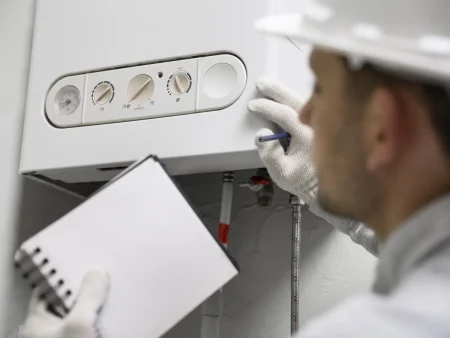
Hard-water minerals can also affect certain water-heating systems. In tank-style water heaters, mineral-related sediment can accumulate over time. As water is heated, certain dissolved minerals may form deposits. Depending on the equipment and water conditions, material can collect inside the water heater.
In some systems, accumulation may contribute to:
However, not every water-heater problem is caused by sediment.
Leaks, inconsistent hot water, and equipment failures can have other causes.
If your water heater is making unusual noises or no longer performing reliably, visit our water heater repair and installation services in Las Vegas.
Mineral deposits can restrict flow through certain components, but low pressure throughout an entire property has several possible causes.
If only one faucet or showerhead has reduced flow, investigate that fixture. Possible causes include mineral deposits, debris, or damaged components.
If multiple fixtures have weak flow, possible causes include:
The distinction matters because replacing a faucet aerator won’t solve a whole-house plumbing issue.
Under certain conditions, restricted water flow can contribute to unusual fixture sounds. For example, water moving through a restricted valve or small opening may produce whistling or other high-pitched noises.
However, plumbing noises have multiple possible causes.
Whistling may involve restricted openings or valves.
Banging may involve water hammer or pipe movement.
Rattling may involve loose supports or vibrating components.
Popping from a water heater may sometimes involve sediment.
The type and timing of the sound help narrow down the source.
Visible mineral deposits can often be managed through routine cleaning. However, the appropriate method depends on the fixture material, finish, and manufacturer’s instructions.
Regularly wipe and clean surfaces where water collects.
Removing deposits before they become heavy can make ongoing maintenance easier.
If a faucet produces an irregular stream, the aerator may contain debris or mineral buildup.
Some aerators are removable and designed for cleaning, while others require fixture-specific procedures.
Follow the manufacturer’s instructions.
Inspect showerhead nozzles for visible deposits.
Use cleaning methods compatible with the fixture’s materials and protective finishes.
Some aggressive cleaners, abrasive pads, and acidic products can damage certain fixture finishes.
Do not assume vinegar or commercial descalers are safe for every material.
If cleaning deposits doesn’t restore normal flow, another issue may exist.
A damaged faucet cartridge, faulty valve, or plumbing restriction may require repair.
Homeowners cannot eliminate mineral deposits through cleaning alone, but routine maintenance can help manage their effects.
Removing standing droplets can reduce the amount of visible residue left behind as water evaporates.
Inspect and clean accessible aerators according to manufacturer instructions when flow becomes irregular.
Pay attention to blocked nozzles and changing spray patterns.
A faucet that constantly drips can leave surfaces repeatedly wet and should be repaired based on the cause of the leak.
Unusual noises, leaks, or declining hot-water performance deserve attention.
If mineral buildup is a recurring concern, investigate water hardness and treatment options before choosing equipment.
For a broader preventive approach, follow our plumbing maintenance checklist for Las Vegas homeowners.
Visible scale alone may not require plumbing repair.
However, professional evaluation may be appropriate when mineral buildup occurs alongside other symptoms.
Examples include:
A proper diagnosis helps distinguish a cleaning concern from a mechanical or plumbing-system problem.
For available services, explore our Las Vegas plumbing services.
Mineral buildup can restrict showerhead openings and reduce flow. However, problems with the shower valve, plumbing, or water supply can cause similar symptoms.
No. Scale is mineral material deposited from water. Corrosion involves deterioration of the underlying material through chemical or electrochemical processes.
Mineral deposits can accumulate in toilet bowls, tanks, and certain water-exposed components.
However, running toilets and flushing problems may involve worn or malfunctioning mechanical parts.
Hard-water minerals can contribute to sediment or scale accumulation in some water-heating equipment.
The effect depends on the heater type, water conditions, maintenance, and equipment condition.
There is no universal schedule.
Cleaning frequency depends on water hardness, fixture use, surface materials, and how quickly deposits accumulate.
Follow manufacturer recommendations and use methods compatible with the fixture finish.


 Americanwood St, Las Vegas, NV 89130, United States
 savemorehm@gmail.com
Get a Free Estimate Today!
Call us for a cost estimate over the phone.
Copyright © 2026 Save More Handyman Services. All rights reserved